Safely Clean Roof Shingles in Fall City, WA
To clean a roof in Fall City without damaging shingles, use a low-pressure soft wash — under 500 PSI at the surface — paired with a properly diluted sodium hypochlorite solution (typically 1%–3% active), a gentle top-down application, and a controlled downward rinse. Never pressure-wash asphalt shingles. Never scrub upward against the grain. Work on cool, overcast days and protect landscaping before you start.
That's the short answer. The longer answer matters, because Fall City's steep-pitch rooflines, dense Douglas fir canopy, and roughly 55+ inches of annual rainfall create moss and algae conditions that punish shortcuts. Below is the exact process a homeowner in the Snoqualmie Valley should follow — or ask a contractor to follow — to protect the shingles you're paying to clean.
Why do Fall City roofs need such a careful cleaning method?
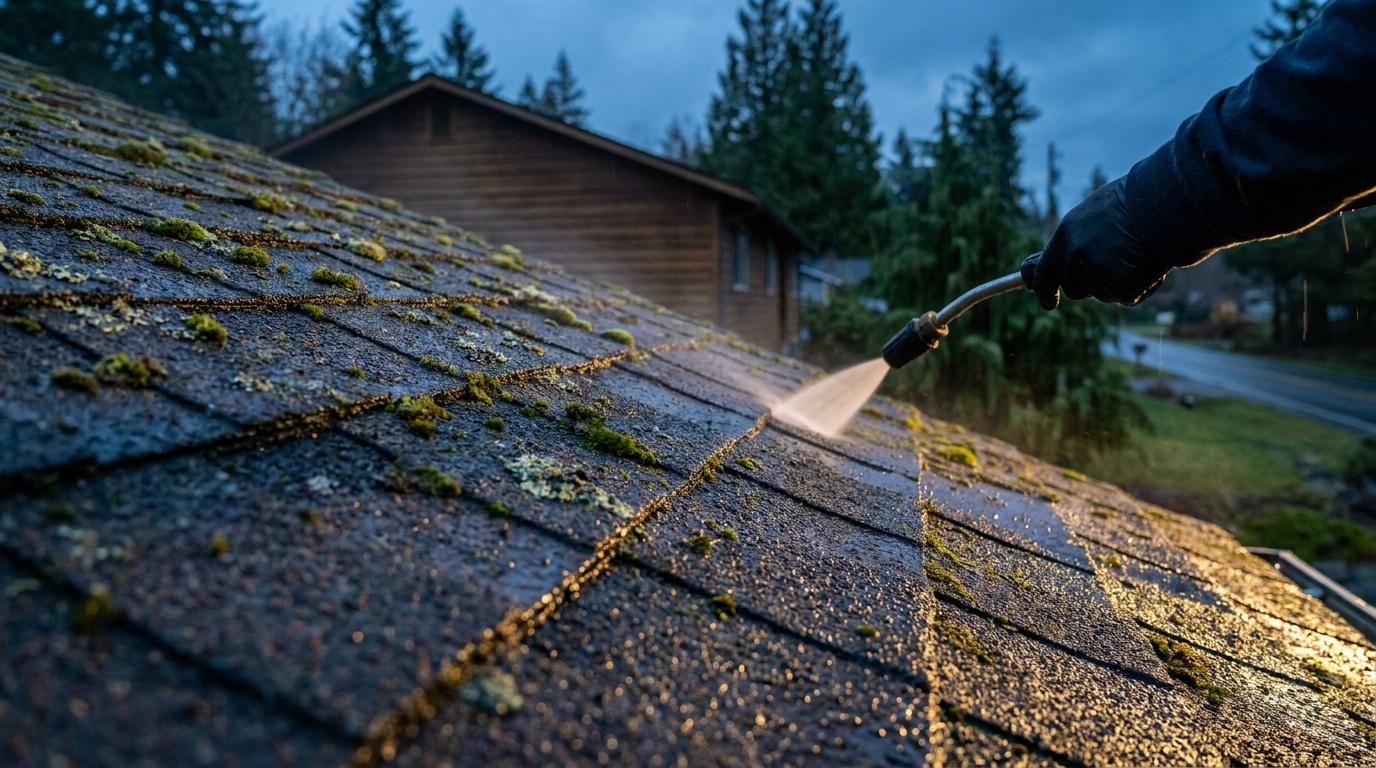
Fall City sits in a wet, shaded microclimate along the Snoqualmie River, where moss, lichen, and gloeocapsa algae thrive on north-facing asphalt shingles almost year-round. Aggressive pressure washing strips granules — the UV shield that gives shingles their 20–30 year lifespan — and voids most manufacturer warranties. Soft washing is the only shingle-safe method endorsed by the Asphalt Roofing Manufacturers Association (ARMA).
The Pacific Northwest's persistent moisture means moss doesn't just sit on top of shingles — its rhizoids work under the tabs, lifting them and holding water against the mat. By the time you can see thick green cushions from the driveway, the biological damage is already underway. That's why timing and technique both matter here more than they would in a drier climate.
What water pressure is actually safe for asphalt shingles?
Safe roof cleaning uses low-pressure soft washing at 100–500 PSI measured at the nozzle — closer to a strong garden hose than a pressure washer. Standard consumer pressure washers deliver 1,800–3,200 PSI, which will blast granules off shingles in a single pass. ARMA's official position is that no high-pressure washing should ever be used on asphalt roofing.
A proper soft wash rig uses a 12V or air-driven pump to deliver cleaning solution at low pressure through a fan-tip nozzle. The chemistry does the work, not the water. When Velocity Cleaning Systems services steep-pitch homes around Fall City and the Snoqualmie Valley, the operator on the roof (or on a ladder) is essentially misting — not blasting — the surface.
How should the cleaning solution be mixed?
The industry-standard mix for shingle-safe roof cleaning is sodium hypochlorite diluted to 1%–3% active concentration, combined with a surfactant to help it cling to sloped surfaces. Higher concentrations damage plants and shorten shingle life; lower concentrations don't kill moss and algae reliably in a single application. A surfactant matters as much as the bleach ratio on Fall City's steep pitches.
Skip additives that aren't formulated for roofs — trisodium phosphate, undiluted pool chlorine, or generic "deck cleaners" can strip color, corrode metal flashing, and violate King County stormwater rules if runoff reaches storm drains or the Snoqualmie River watershed. Pre-wet all landscaping below the eaves, and rinse it again after the work is done.
What's the correct step-by-step process for a Fall City home?
The correct sequence is: inspect, protect, apply, dwell, rinse, evaluate. Skipping steps is where DIY roof cleaning goes wrong. Below is the process a Fall City homeowner should follow — and the same order a qualified contractor should be able to walk you through before they start.
- Inspect the roof. Check for lifted shingles, exposed nails, cracked pipe boots, and moss thickness. If moss cushions are more than an inch thick, plan on two applications spaced weeks apart rather than one aggressive pass.
- Protect the site. Pre-soak all shrubs, garden beds, and lawn within 10 feet of the drip line. Cover delicate ornamentals. Close all windows. Redirect downspout extensions away from planted areas.
- Apply top-down. Start at the ridge and work down the slope so solution runs with gravity, never against overlapping shingle tabs. Use a fan tip; keep the wand 12–18 inches off the surface.
- Let it dwell. 15–30 minutes of dwell time lets the solution kill biological growth. Do not scrub. Do not walk on wet, treated shingles — granule loss spikes when the surface is saturated.
- Rinse gently, downward only. A garden hose with a standard spray nozzle is usually enough. If a low-pressure rinse is needed, keep it under 500 PSI and always aim down-slope.
- Re-rinse landscaping. Flood plants and lawn with fresh water for several minutes to dilute any drift.
When is the best time of year to clean a roof in Fall City?
The best window for roof cleaning in Fall City is late spring through early fall — roughly May through September — when shingles are dry enough for solution to cling and dwell without being immediately washed off by rain. Cleaning ahead of the fall rainy season lets treated surfaces shed water cleanly through winter, when moss regrowth accelerates under the Snoqualmie Valley's persistent cloud cover.
Avoid cleaning in freezing temperatures, direct midday sun (solution evaporates too fast), or right before a forecasted downpour. Overcast, dry, 55–75°F days are ideal — which describes a lot of Fall City afternoons from June through September.
What does professional roof cleaning cost in Fall City in 2026?
Professional soft-wash roof cleaning in the Fall City and greater Snoqualmie Valley market typically runs $0.30–$0.75 per square foot of roof area in 2026, with most single-family homes landing between $450 and $1,200 depending on pitch, access, moss load, and roof size. Steep-pitch homes and homes with limited ladder access sit at the higher end because two-person crews and fall-protection setup take longer.
| Home Size / Complexity | Typical 2026 Price Range | Time on Site |
|---|---|---|
| Single-story, moderate pitch, light moss | $450 – $650 | 2–3 hours |
| Two-story, standard pitch, moderate moss | $650 – $900 | 3–5 hours |
| Steep-pitch or complex roofline, heavy moss | $900 – $1,500+ | 5–8 hours |
| Cedar shake or tile (specialty) | Quoted individually | Varies |
Velocity Cleaning Systems holds a 4.9★ rating across 21 Google reviews, with one recent Fall City-area client noting the crew was "quick to respond" for a roof de-mossing job. Ask any contractor for proof of Washington L&I contractor registration and general liability insurance before work begins — both are required for roof work in King County.
What should you look for in a Fall City roof cleaning company?
Look for four things: a Washington State contractor license (verifiable through L&I), general liability insurance naming roof work, a written commitment to low-pressure soft washing rather than pressure washing, and clear documentation of the chemistry and dilution they use. Anyone offering to "pressure wash" asphalt shingles has already disqualified themselves.
Ask specifically whether they'll walk the roof or work from ladders and extended wands, how they protect landscaping, and whether they carry a workmanship guarantee. Reviewers of Velocity Cleaning Systems consistently note punctuality, before-and-after photo documentation, and direct owner involvement — the kind of accountability that's hard to fake and easy to verify.
Frequently Asked Questions
Can I pressure wash my own roof if I'm careful?
No. Even at the lowest setting, a standard pressure washer produces 1,800+ PSI at the nozzle — enough to strip protective granules from asphalt shingles in a single pass and void your manufacturer warranty. The Asphalt Roofing Manufacturers Association explicitly warns against pressure washing shingles. Use a soft-wash approach with a garden hose and appropriate cleaning solution, or hire a contractor equipped for low-pressure roof cleaning.
Will roof cleaning kill the plants around my house?
Not if the site is properly prepped. Pre-soaking all shrubs and lawn within 10 feet of the drip line dilutes any solution drift, and a thorough post-rinse flushes residual chemistry off foliage. Problems occur when contractors skip pre-wetting, use over-concentrated bleach mixes, or fail to rinse landscaping after the work. Ask any contractor how they handle plant protection before you sign.
How often should a Fall City roof be cleaned?
Most Fall City homes benefit from a full soft-wash roof cleaning every 3–5 years, with a lighter moss treatment or zinc strip refresh in between. The Snoqualmie Valley's shaded, damp climate produces faster moss regrowth than drier parts of Washington. North-facing slopes and homes under Douglas fir canopy tend to need attention on the shorter end of that range; sunnier, more exposed roofs can often go longer between full cleanings.
Is there a permit required to clean a roof in King County?
No permit is required for routine residential roof cleaning in Fall City or unincorporated King County. However, contractors performing the work must be registered with Washington State Labor & Industries, and any runoff must comply with King County's stormwater regulations — meaning cleaning solutions cannot be allowed to flow directly into storm drains or the Snoqualmie River watershed. Reputable local contractors already build this into their process.
What's the difference between soft washing and pressure washing?
Soft washing uses low pressure (100–500 PSI) combined with cleaning chemistry to kill moss, algae, and lichen at the biological level, then rinses gently. Pressure washing uses high-velocity water (1,800–4,000 PSI) to physically blast contaminants off surfaces. Soft washing is the shingle-safe method for asphalt roofs; pressure washing is appropriate for concrete, some sidings, and driveways — never for roofing.
Should I install zinc or copper strips after cleaning?
Yes, in most Fall City cases. Zinc or copper ridge strips release trace metal ions when it rains, which inhibit moss and algae regrowth on the slopes below. In the Pacific Northwest's damp climate, they can meaningfully extend the time between full roof cleanings. Many contractors offer strip installation as an add-on service after a soft wash — it's one of the higher-value preventive upgrades for a Fall City home.
Getting the job done right
Cleaning a Fall City roof the right way is less about muscle and more about restraint — the correct pressure, the correct chemistry, the correct sequence, and the correct season. Get those four right and the shingles you're cleaning will keep their granules, their warranty, and another decade or more of service life.
Homeowners in Fall City and the wider Snoqualmie Valley who want this handled professionally can reach Velocity Cleaning Systems at https://velocitycleaningsystems.com/ to schedule an inspection or ask questions about their specific roof.