
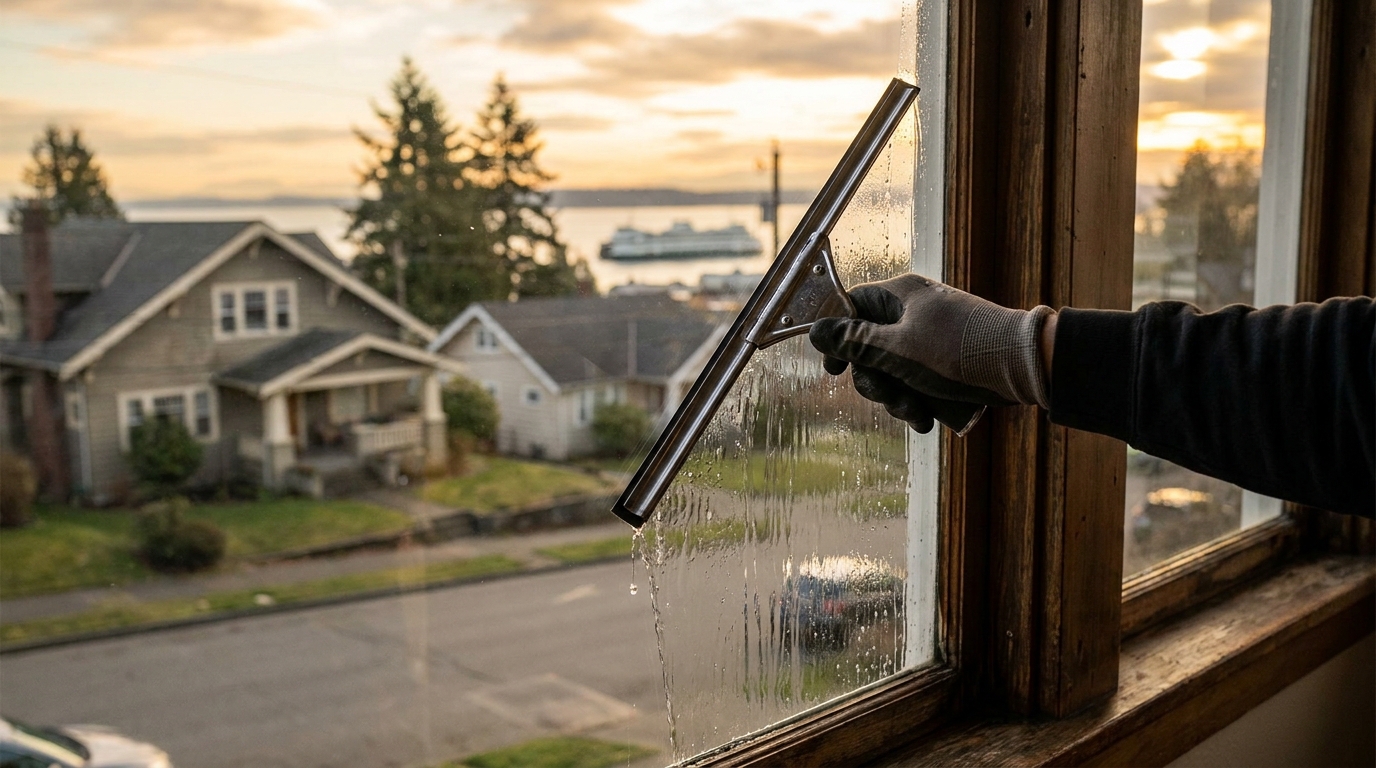
Streak-Free Window Washing Techniques in Everett, WA
Professional window washers get streak-free results by combining pure water (either deionized or filtered), a properly conditioned squeegee with a fresh rubber blade, and a disciplined stroke pattern that pulls water off the glass in one continuous path. The streaks most homeowners fight aren't caused by dirty glass — they're caused by mineral-heavy tap water, worn rubber, and cotton towels that shed lint. Change those three variables and the streaks disappear.
If you've ever cleaned your windows on a bright Saturday only to see ghost lines and haze once the sun hit them, you already know the frustration. In Everett, WA, where marine air off Port Gardner Bay and long stretches of drizzle leave a fine mineral film on glass, the DIY approach hits its limits fast. Here's how the pros actually do it — and why the results look so different.
Why do professional window washers get streak-free results?
Professionals get streak-free results because they control three variables amateurs don't: water purity, blade condition, and stroke technique. They use deionized or filtered water instead of Everett's mineral-containing tap water, replace squeegee rubber every few jobs, and pull the blade in overlapping, angled strokes that leave zero standing water on the glass.
The team at Velocity Cleaning Systems has seen firsthand that most streaking complaints trace back to one of those three inputs — not to the glass itself. Fix the inputs and the outcome fixes itself.
What water do window cleaners use to avoid streaks?
Professional window cleaners use purified water — most commonly deionized (DI) or reverse-osmosis (RO) water with a total dissolved solids (TDS) reading near zero parts per million. Tap water in the Everett area typically runs between 20 and 60 ppm TDS, and those minerals are exactly what dry into the spots and streaks homeowners see afterward.
For exterior work, especially on second-story panes, many pros use a water-fed pole system: purified water pumped through a carbon-fiber pole to a soft brush head. Because the rinse water has nothing dissolved in it, glass air-dries spot-free. No squeegee, no ladder against the siding, no soap residue.
What tools do professional window washers use?
Professional window washers rely on a compact, deliberate toolkit: a brass or stainless channel squeegee with replaceable rubber, a strip washer (T-bar with a microfiber sleeve), a bucket with a Pjur-style cleaning solution, scrim or waffle-weave microfiber towels, a razor scraper for hard debris, and — increasingly — a water-fed pole system for exteriors.
- Channel squeegee: Brass or stainless steel, sized to the pane. The rubber blade is the wear part and gets rotated or replaced often.
- Strip washer: Loads solution onto the glass and lifts grime without scratching.
- Scrim or waffle-weave microfiber: Used to detail edges and corners — never cotton terry, which sheds lint.
- Razor scraper: For paint flecks, sap, or hard water spots (only on tempered, non-tinted glass).
- Water-fed pole: Reaches upper-story windows safely with purified water and a soft brush.
How does the professional squeegee technique actually work?
The professional squeegee technique uses overlapping, angled pulls that push water off the glass in one continuous motion, ending each stroke on a dry section. The blade is tilted about 30 degrees, pressure is light and even, and the top edge of the rubber is wiped between passes. This leaves no standing water — which means nothing to dry into a streak.
There are two dominant patterns: the straight pull (top-to-bottom, overlapping each stroke by about an inch) and the fan or S-pattern (a continuous snake across the pane without lifting). Fan technique is faster and preferred by veterans, but straight pulls are more forgiving. Both work — inconsistency between them is what causes streaks.
Why does Everett's climate make streak-free windows harder?
Everett's marine climate is uniquely tough on glass. The Puget Sound region averages roughly 168 rainy days per year, and that constant misting deposits airborne minerals, pollen, and diesel particulates from I-5 and the Port of Everett onto exterior panes. When the sun finally breaks through, every water spot shows.
Neighborhoods closer to the waterfront — think Port Gardner, Bayside, and homes along Mukilteo Boulevard — pick up extra salt spray, which bonds to glass and resists plain-water rinsing. Homes further inland toward Silver Lake or the Cascade High School corridor deal with more pollen and organic film from Douglas fir and cedar. Different films, same solution: purified water and a fresh blade. Timing matters too — the stretch from late March through May, before pollen peaks, is when most Everett homeowners schedule their first professional cleaning of the year.
How much does professional window washing cost in Everett, WA?
Professional window washing in Everett, WA typically runs between $8 and $15 per pane for standard residential work, with most single-family homes falling in the $250 to $550 range depending on pane count, story height, and whether tracks and screens are included. Add-ons like hard-water spot removal, skylights, or post-construction cleanup are usually priced separately.
| Service Level | What's Included | Typical Everett Range (2026) |
|---|---|---|
| Exterior Only | Outside glass, water-fed pole rinse | $150 – $300 |
| Interior + Exterior | Both sides of glass, sills wiped | $250 – $450 |
| Full Detail | Glass, tracks, screens, frames | $350 – $650 |
| Hard-Water Restoration | Mineral spot removal treatment | +$50 – $150 per affected window |
What should Everett homeowners look for in a window washing company?
Everett homeowners should look for a licensed, insured company with a Washington State business license (verifiable at dor.wa.gov), documented liability coverage, transparent written estimates, and a track record of local reviews. Ask specifically whether the company uses purified water systems and how often they replace squeegee rubber — those two answers tell you almost everything about the finish you'll get.
Velocity Cleaning Systems holds a 4.8-star rating across 19 Google reviews, with customers repeatedly citing responsiveness, punctuality, and detailed written estimates. One recent reviewer described the experience as "seamless from start to finish" — which lines up with how any well-run window washing operation should feel, from first quote to final walk-through.
Frequently Asked Questions
How often should Everett homeowners have their windows professionally cleaned?
Most Everett homes benefit from professional window cleaning twice a year — once in spring (April or May) after pollen season winds down, and once in early fall before the heavy rain returns. Waterfront homes near Port Gardner or Mukilteo Boulevard may want a third cleaning mid-summer to handle salt spray buildup. Commercial storefronts typically need monthly service.
Can I just use vinegar and newspaper to get streak-free windows?
Vinegar and newspaper can work on small, lightly soiled panes, but they fail on hard-water spots, heavy exterior grime, and large windows. Vinegar is too weak to break down the mineral film Everett's marine air deposits, and newspaper ink runs when the glass is genuinely wet. Professionals use surfactant-based solutions and purified water because they actually dissolve and rinse residue away.
Why do my windows streak worse after I clean them?
Windows streak worse after cleaning for three main reasons: you used tap water containing minerals that dried into spots, your squeegee blade is nicked or worn, or you cleaned in direct sunlight and the solution evaporated before you could pull it off. Clean on an overcast day, use purified water, and check your blade before you start.
Do professional window washers clean screens and tracks too?
Most professional window washing packages in Everett include screen removal and rinsing plus a wipe-down of the sills, but full track detailing (vacuuming and scrubbing the channels) is often an add-on. Ask upfront — a detailed written estimate should list exactly what's included so there are no surprises when the crew arrives.
Is water-fed pole cleaning as effective as traditional squeegee work?
Yes, water-fed pole cleaning is equally effective for exterior glass when the system uses truly purified water (near-zero TDS) and the operator brushes long enough to lift the grime. It's actually safer and more thorough for second-story windows than ladder-and-squeegee work, because the pole reaches every corner without the technician needing to shift position mid-pane.
Will professional window cleaning damage older wood-framed windows?
No, professional window cleaning shouldn't damage older wood-framed windows when the technician uses controlled water volume and wipes frames dry as they go. This matters in older Everett neighborhoods like Riverside and Northwest Everett, where homes from the early 1900s still have original single-pane wood sashes. Reputable companies adjust their technique for older glazing and putty rather than blasting it with water.
The bottom line on streak-free windows
Streak-free glass isn't magic — it's the sum of purified water, sharp rubber, and disciplined technique. Homeowners in Everett, WA who want the difference handled by professionals, especially before spring pollen or after a long rainy stretch, can reach Velocity Cleaning Systems at https://velocitycleaningsystems.com/ for a written estimate and scheduling.